Yoga Wear Manufacturer: How to Choose the Right Partner
The global activewear market has evolved dramatically over the last decade, transitioning from basic gym wear into a sophisticated blend of high-performance technology, everyday lifestyle fashion, and specialized ergonomics. Whether you are building an emerging direct-to-consumer (DTC) activewear line or scaling an established fitness brand, one of the most critical operational choices you will make is selecting the right yoga wear manufacturer. Having spent years advising apparel founders and procurement managers, I can tell you firsthand that your factory relationship directly dictates your brand’s customer satisfaction, cash flow agility, and long-term profitability.
A recurring obstacle for growing labels is navigating minimum order quantities (MOQs). Traditional large-scale factories often demand massive initial commitments (often reaching 10,000 units per style/color), which may be financially unfeasible for new brands. Conversely, smaller manufacturers might offer lower MOQs (e.g., 100 to 200 units) but at a higher cost per unit. It is vital to find a flexible yoga wear manufacturer that balances cost and quality, as detailed in this industry reference. Achieving this balance allows you to protect your working capital while validating market demand.
Understanding MOQs and Inventory Cash Flow
When auditing a potential yoga wear manufacturer, looking solely at FOB (Free on Board) unit pricing can be misleading. In my experience, securing a low unit price with an excessively high MOQ frequently leads to capital tied up in slow-moving inventory. If a design needs tweaks based on initial customer feedback, you are left holding excess stock. On the other hand, accepting slightly higher unit costs for lower MOQs gives your brand crucial inventory flexibility. You can test new colors, sizes, and cuts in real-world market conditions, iterate quickly, and reorder high-performing lines without risking operational solvency.
Here is a practical breakdown of how MOQ tiers typically affect your operations:
- Low-Volume Tier (100 – 300 units per style/color): Ideal for startups, boutique labels, and limited capsule drops. It minimizes financial exposure while testing market interest.
- Mid-Volume Tier (500 – 1,000 units per style/color): Perfect for scaling DTC brand with proven core styles. Offers better margins while keeping inventory commitments reasonable.
- High-Volume Tier (5,000+ units per style/color): Suited for established global brands and major retailers with predictable sales velocity. Yields the lowest per-unit cost but requires heavy capital commitment.
Technical Standards to Look for in Activewear Production
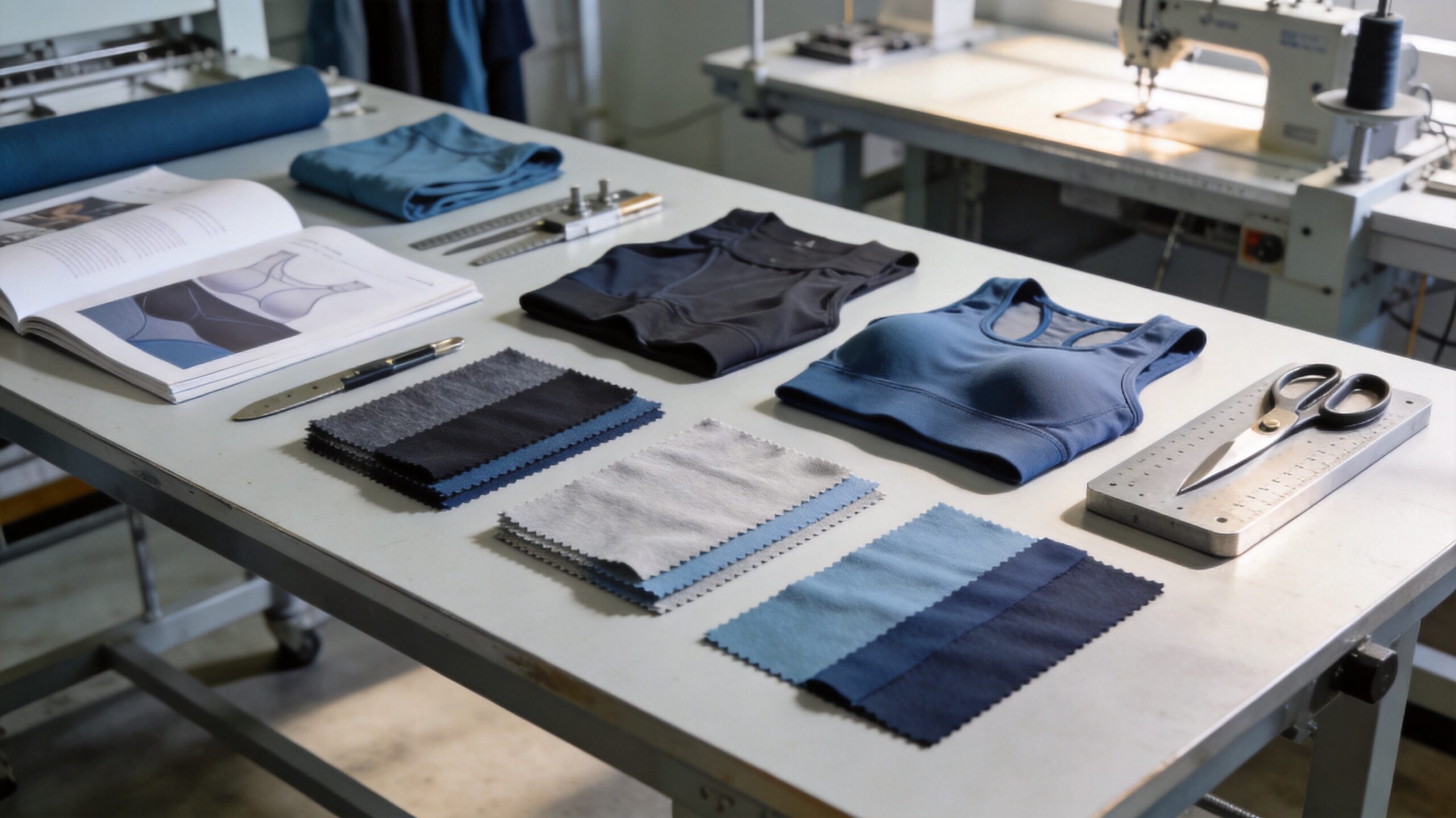
Yoga wear requires far higher technical engineering than conventional knitted streetwear. Garments must withstand intense physical stretching, maintain opacity during movement (the crucial ‘squat-proof’ test), and offer seamless moisture management. From what I have seen across the industry, cutting corners on raw materials or seam strength is the fastest way to generate high refund rates and poor product reviews. When evaluating potential partners, insist on analyzing the following technical benchmarks:
- Fabric Composition & Elastane Quality: Activewear typically utilizes premium nylon/spandex or polyester/spandex blends (e.g., 75/25 or 80/20 ratios). High-quality four-way stretch fabrics provide compression without restricting movement.
- Seam Construction: Look for four-needle six-thread flatlock stitching. Flatlock seams lay flat against the skin, preventing chafing and ensuring exceptional tensile strength along stress points.
- Pattern Grading Precision: Ensure the manufacturer has in-house technical pattern makers who understand how stretch fabrics behave across different body proportions in full size runs.
Comparing Production Partners for Your Brand Phase
| Factory Category | Typical MOQ Range | Unit Cost Level | Operational Agility | Recommended Brand Stage |
|---|---|---|---|---|
| Small-Batch Specialist | 100 – 300 units | Moderate to High | High (Fast testing & turnaround) | Startups & Niche Capsule Lines |
| Mid-Scale Manufacturer | 500 – 1,000 units | Balanced | Medium (Scheduled production runs) | Growing DTC Brands |
| Mass-Production Hub | 5,000+ units | Lowest per unit | Low (Long lead times) | Enterprise Retailers |
Designing for Modern Consumer Demand
Today’s consumers demand activewear that moves effortlessly from intense workout sessions to relaxed everyday environments. Unique design features—such as cross-waist details, delicate contrast binding, and retro flare cuts—have become key differentiators in modern activewear lines.
To explore potential designs, you can browse our product catalog, which features high-quality options like our flared yoga set. Incorporating trend-forward yet highly functional silhouettes enables your activewear brand to stand out in a crowded digital space and command healthier gross margins.
The Importance of Prototyping and Quality Audits
Before authorizing a full production run, thorough sampling is mandatory. I always advise founders to order pre-production samples (PPS) to test fit consistency, wash longevity, and elasticity retention under tension. A reliable manufacturing partner will engage transparently during the sampling phase, offering constructive technical advice to refine your garment’s fit and finish.
Frequently Asked Questions (FAQ)
What is a typical MOQ for a custom yoga wear manufacturer?
Minimum order quantities vary considerably. Boutique and small-batch specialists typically offer MOQs between 100 and 300 units per style/color, while tier-one industrial suppliers require 1,000 to 10,000 units per order.
How do I evaluate sample quality before committing to bulk production?
Examine seam stretch under tension, check for sheer spots in daylight when stretched, verify dimensions against your Tech Pack, and run wash tests to inspect shrink rates and color fastness.
Why is four-way stretch fabric critical for yoga apparel?
Four-way stretch fabric expands horizontally and vertically, allowing activewear to stretch with bodily movements while recovering its original shape without sagging or losing compression.
Final Thoughts: Building a Scalable Supply Chain Partnership
Finding the right yoga wear manufacturer is not simply a search for the lowest unit cost; it is about building a reliable strategic collaboration. By striking the right balance between minimum order quantities, rigorous quality standards, and design innovation, you position your brand for sustainable, profitable growth.